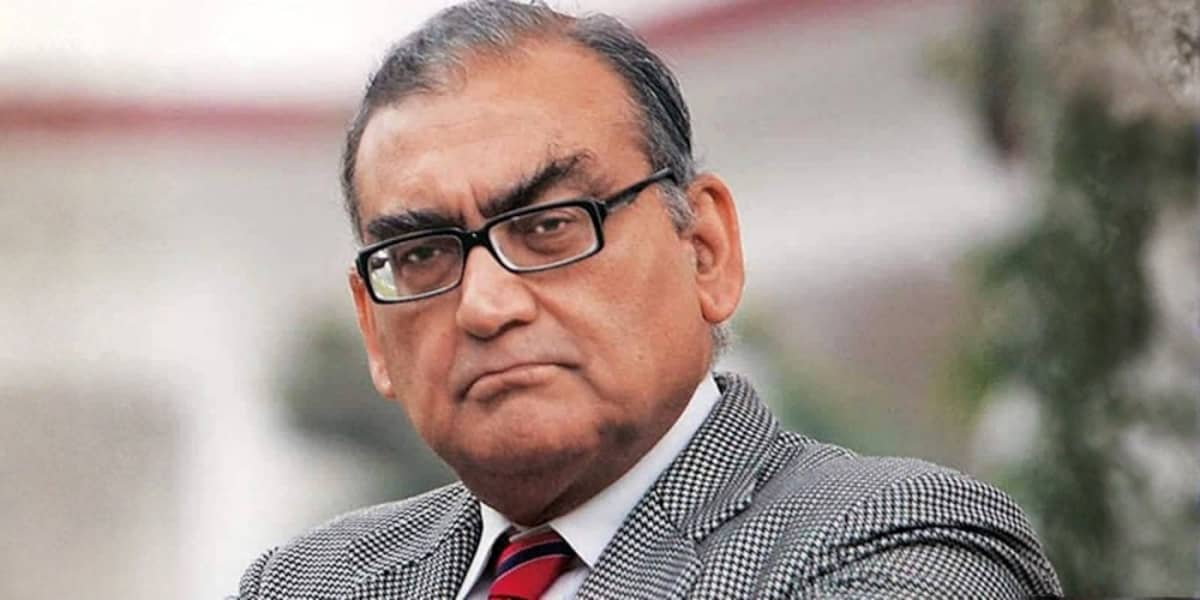

North Delhi: Former Supreme Court judge Markandey Katju delivered a speech at a programme held in the name of Shaheed Bhagat Singh, where he shared his views on India’s freedom movement and the direction taken after independence. The programme was organised by Pratibimb Educational Welfare and Society and was titled “Shaheed Bhagat Singh Desh Ka Gaurav Puraskar.”
Beginning his address, Markandey Katju said that as soon as he learned that the programme was being organised in the name of Shaheed Bhagat Singh, he decided to attend it. He clarified that he was expressing his personal beliefs and that it was not necessary for everyone to agree with them.
Katju stated that, in his view, the correct path for India was the one shown by Bhagat Singh, but the country chose to follow Mahatma Gandhi’s path instead. He said that Bhagat Singh’s path was that of armed struggle, while Gandhi’s path was based on satyagraha and hunger strikes.
He also questioned the commonly held belief that Gandhi gave India freedom. According to Katju, real freedom means freedom from poverty, unemployment, hunger, lack of healthcare facilities, and the absence of good education. He said that today the condition of India is such that a large section of the population is suffering from severe poverty, unemployment is continuously increasing, hunger remains a serious problem, and every second child in the country is malnourished. He added that if people do not get enough food to eat, it cannot be described as real freedom.
In his speech, Katju further said that the public has been misled in the name of freedom. He then described his views as “fundamental” and spoke about the true objective of the nation.
Markandey Katju said that India’s goal should be to transform itself into a developed and great industrial nation, similar to China and the United States. He also said, “India has to be transformed into a modern industrial giant like China and the USA.”
He argued that unless India becomes industrially strong, it will not be possible to eliminate poverty, unemployment, hunger, or the lack of healthcare services. He said that a harsh reality of the world is that the poor are not given respect, and if a country wants dignity, it must transform itself into a great industrial nation.